Case study: an evidence-first website for a Hyderabad business school
The short answer
Chanakya School of Modern Management is a postgraduate business school with three Hyderabad campuses and seven programmes. We built a site that lets a graduate and their parents compare programmes, see published fees and book counselling, with copy that states only what the school can show. Scope, timeline and results remain [Confirm].
On this page
- The short answer
- At a glance
- What does an evidence-first website mean for a business school?
- How is the site structured for families comparing colleges?
- How does the filterable programme catalogue work?
- Why label stock photographs on a college website?
- Why does this approach suit admissions in Hyderabad?
- What can other institutions take from Chanakya's site?
- What to do next
- What to take away
- Questions, answered
Most college websites in India describe themselves with the same handful of words. Premier, leading, renowned faculty, holistic. Families have read them all, and they skip them. What they want is the fee, the approval, the intake date and a person to speak to.
Chanakya School of Modern Management is a postgraduate business school in Hyderabad with seven programmes across three campuses. The brief was plain: help a graduate and their parents compare seven programmes, see the fees and book counselling. You can see the summary on our Chanakya work page.
At a glance
- Client: Chanakya School of Modern Management, postgraduate business education, Hyderabad
- What we built: a filterable catalogue of seven programmes, a published fees section, the admissions process, a counselling form, evidence-first copy across the site, labelled stock photography
- Platform: Next.js
- Scope and timeline: [Confirm]
- Results: [Confirm with the client]
What does an evidence-first website mean for a business school?
An evidence-first website replaces descriptive claims with things a family can check. Instead of calling a programme industry-focused, the page says when paid internships begin. Instead of saying the school is recognised, it names the approval and the body behind it. The copy states what the school can show, and stops there.
The Chanakya site says this in its own section heading: "Evidence, not adjectives." Under it, six cards set out the reasons families ask about most, each drawn from what the institution publishes rather than from house copy. Approvals and affiliations. Career building from the second semester. Overseas authentication of the diploma for families thinking about study or work abroad later. Industry 4.0 courses alongside the core syllabus. Three routes into a global degree. Fees and dates set out clearly.
None of those cards uses a superlative. Each one answers a question a parent would otherwise ask on the phone.
How is the site structured for families comparing colleges?
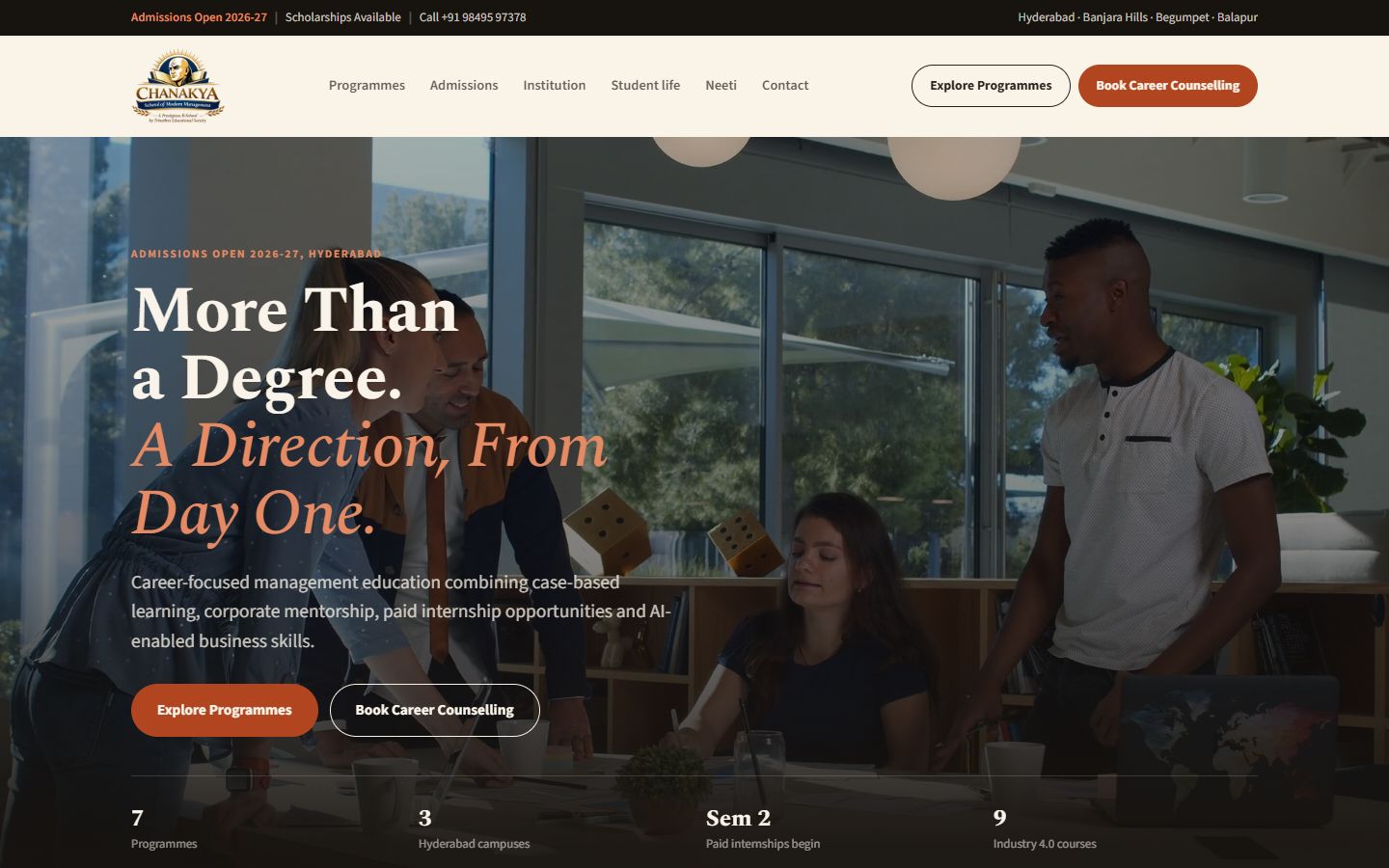
The home page runs in the order a family decides: the promise, the key facts, the evidence, the programmes, the fees and dates, then admissions and a counselling form. Each section answers one question. A family that only reads the first screen still learns the number of programmes, the number of campuses and when internships begin.
How a family moves through the Chanakya site
From the widest stage to the narrowest:
- First screen: Promise, key figures, two clear actions
- Evidence: Six reasons, each one checkable
- Catalogue: Filter seven programmes by level and interest
- Fees and dates: Annual fees and scholarship criteria published
- Counselling: Admissions steps and a short form
The top bar carries the details families look for before anything else: that admissions are open for the coming year, that scholarships are available, a phone number, and the campus areas, Banjara Hills, Begumpet and Balapur. The hero states the promise, "More Than a Degree. A Direction, From Day One.", and offers two actions: explore programmes, or book career counselling. Below it sit four figures: seven programmes, three Hyderabad campuses, paid internships from semester two, and nine Industry 4.0 courses.
The main navigation is kept to six plain words: Programmes, Admissions, Institution, Student life, Neeti and Contact. The two actions, explore programmes and book career counselling, stay in the header on every page, so a family who is ready to talk never has to scroll back to find the button. We chose one label for the counselling action and used it everywhere. A button that says "Enquire" in one place, "Apply" in another and "Talk to us" in a third makes a family wonder whether they are three different things.
A short paragraph then explains what the institution is for and who sponsors it, in the school's own published terms, before the evidence section begins.
How does the filterable programme catalogue work?
The catalogue shows all seven programmes as cards and lets a visitor filter by level and by interest. Levels are postgraduate, specialised and doctoral. Interests include management, technology, healthcare, hospitality, real estate and research. A line above the cards confirms how many programmes match, so a family always knows what they are looking at.
Each card carries the same fields in the same order: the programme name and full title, a one-line description, the awarding body, duration, eligibility, intake, and the fee per year. Consistency is the point. A parent comparing an MBA with a PGDM, or a specialised programme in healthcare management with one in hospitality, can scan across cards without hunting.
Where a detail is not fixed for every applicant, the card says "Confirmed at counselling" rather than printing a guess. That small phrase does real work. It is honest about what varies, it gives the counselling call a clear purpose, and it means the school never has to correct a number a family has already screenshotted and shared on WhatsApp.
On a phone, the cards stack, the filters stay one tap away, and the counselling button stays within reach.
Why label stock photographs on a college website?
Families judge a campus by its photographs, so a stock photo presented as the real campus is a quiet breach of trust. On the Chanakya site, images are labelled as stock or as real photographs until the school supplies its own. It is a small decision that tells a careful parent the rest of the page can be believed.
Many institutions launch with stock imagery because their own photography is not ready. That is a practical reality, not a failing. The failing is pretending. Labelling buys time honestly, and it creates a clear next step for the school: real campus photography to replace the labelled stock, which is on our list of next steps for this project as [Confirm].
Why does this approach suit admissions in Hyderabad?
Postgraduate admissions in Telangana move quickly once entrance results arrive, and families compare several institutions at the same time, often on a phone and often after a relative shares a link. A site that answers fees, approvals and intake on the first visit stays in the comparison. A site that makes them call to find out often drops out of it.
Business school applicants in Hyderabad typically weigh entrance routes such as national tests and the state's own common entrance test, along with campus location and commute. A family in the west of the city will look at travel time to Banjara Hills or Begumpet differently from a family nearer Balapur. Putting campus areas in the top bar, rather than on a contact page, answers that early.
The same structure also helps search. A programme card with a clear title, awarding body and fee is easy for Google to understand and for AI assistants to quote accurately. Programme pages shaped for AI answers are a noted next step, [Confirm]. We explain the method in our guide to answer engine optimisation.
What can other institutions take from Chanakya's site?
Start by listing the six questions families ask most, then find the published fact that answers each one. If a fact does not exist yet, either create it or leave the claim out. Then build one catalogue where every programme uses the same fields, with fees in plain view and an honest phrase for anything that varies.
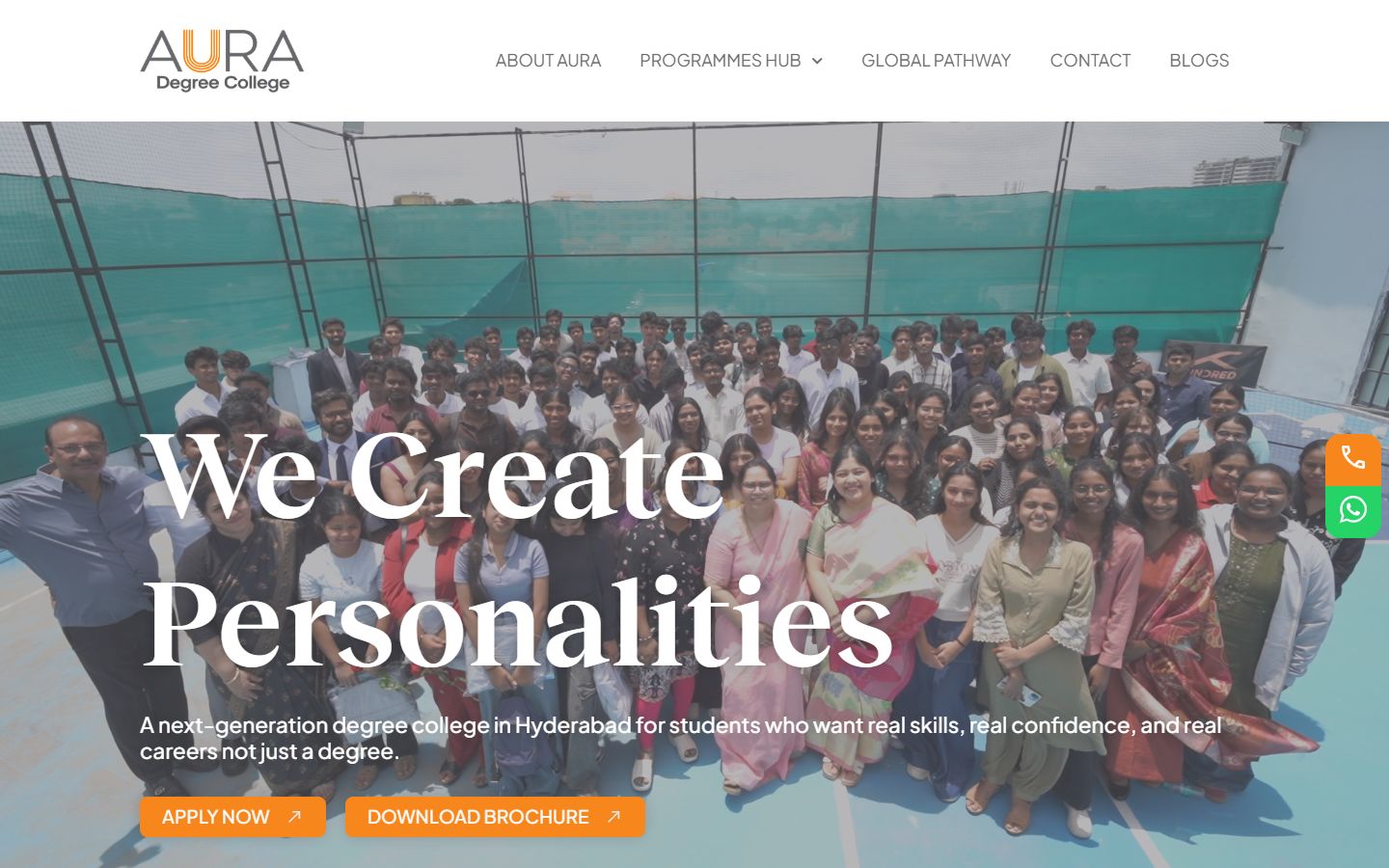
For the wider picture across schools and colleges in the state, read our playbook on school and college admissions websites in Telangana. For a different approach in the same city, see our case study on AURA's campaign page and full college site. And for the thinking behind it, read built on intent: why every page should have a job.
What to do next
Take your current home page and underline every adjective. For each one, write the fact that would make a parent believe it. Where you cannot find the fact, you have found your next piece of work.
If you would like a hand, see how we build websites and platforms and search and AI visibility, browse our work, or book a call. We work with institutions across Hyderabad and Telangana.
What to take away
- 'Evidence, not adjectives' is a copy rule: every claim points to something the institution publishes.
- A filterable catalogue lets families narrow seven programmes by level and interest in one view.
- Where a detail is not fixed, the card says 'Confirmed at counselling' instead of guessing.
- Stock photographs are labelled as stock until the school supplies its own.
Built on Intent studio. A founder-led studio in India that plans and builds websites, search and AI visibility, and AI systems for businesses in India, the UAE and the UK. Reviewed by [Founder name], founder. We do not publish invented numbers; where a figure appears, its source is named in the sentence.
How the studio works