Built on intent: why every page on your website should have a job
The short answer
A website built on intent is one where every page has a written job before anyone designs it: who it is for, what it must get them to do, and how you will know it worked. Pages without a job still cost money to build, maintain and rank, and they dilute the pages that matter.
On this page
- The short answer
- What does "built on intent" mean for a website?
- Why does a page without a job cost money?
- How do you decide a page's job before building it?
- What does this look like on real websites?
- How does intent help with Google and AI assistants?
- Does this apply differently in India, the UAE and the UK?
- What we say no to
- What to do next
- What to take away
- Questions, answered
Most websites get built before anyone decides what they are for. A designer opens a tool, a template suggests a home page, an about page and a services grid, and the business fills the boxes. Months later the site looks finished but nobody can say what any single page is meant to achieve.
We work the other way round. We decide first, then we build. That habit is what the name means.
What does "built on intent" mean for a website?
A website built on intent is one where every page has a written job before design starts. The job names who the page is for, what you want them to do next, and how you will know it worked. Design, copy, code and search work then serve that job, not a template or a trend.
Intent is not a mood board or a brand adjective. It is a decision you can write in one line and test against later. For example:
- Home page: for a first-time visitor who found us through search or a referral, the job is to show what we do and for whom on the first screen, then route them to the right service page.
- Fees page for a business school: for a parent comparing colleges, the job is to answer the cost question plainly so the counselling call starts with programmes, not price.
- Contact page: for someone who has decided to talk, the job is to make that take one step, on the channel they already use.
If you cannot finish the sentence, the page is not ready to be designed.
Why does a page without a job cost money?
A page without a job is never free. It takes design and build time, it needs updating when prices or people change, it competes with your useful pages for search attention, and it gives visitors one more place to get lost. The cost is quiet, which is why it piles up.
Here is the passage we give clients who ask why we push back on extra pages. Every page you publish creates three ongoing costs. The first is upkeep: someone has to keep it accurate, and an out-of-date page about a service you no longer offer does more harm than no page at all. The second is attention: search engines and AI assistants read your whole site to understand what you do, and ten vague pages blur the picture that three clear ones would draw. The third is the visitor's patience: every extra link in a menu is a choice, and choices slow people down. A page with a job pays these costs back by answering a question, earning a call or proving a claim. A page without a job just keeps charging them. That is why the first question we ask about any page is what it is for, and the second is whether a page you already have could do that job instead.
How do you decide a page's job before building it?
Write one line per page in a shared document before any design work: for this reader, this page must get them to do this, and we will see it in this signal. If two pages share a job, merge them. If a page has no reader, cut it. The list becomes the sitemap.
We use the same short template on every project:
- Reader. Who arrives here, and from where? A parent from a Google search, a facilities manager from a LinkedIn post, a buyer from a WhatsApp forward.
- Question. What are they trying to find out at this moment?
- Action. What should they do once the question is answered? Book a call, download a brochure, read a case study, send a WhatsApp message.
- Signal. What will tell you the page is working? An enquiry tagged with the page, a click to the next step, a search query it starts to appear for.
- Proof. What evidence on the page makes the answer believable? A published fee, a named project, a real photograph, a process.
This is the core of our Decide step, and it ends up on the one-page brief a client signs before design starts.
From intent to a working page
- Reader: Who arrives, and from where
- Question: What they need answered now
- Job: One line, written and agreed
- Build: Copy, design and code serve the job
- Signal: Checked monthly, page kept or changed
What does this look like on real websites?
It looks like pages that answer one question well instead of many questions vaguely. On sites our studio has built, the job of a page is visible in its structure: what comes first, what is published openly, and what single action the page asks for. Three examples from our own work show the habit in practice.
- Chanakya School of Modern Management, Hyderabad. The site's line is "Evidence, not adjectives." Programme pages sit in a filterable catalogue, fees are published in a table, and the admissions process is laid out in steps before the counselling form. Each part has one job: help a student or parent decide whether to talk. See the Chanakya case study.
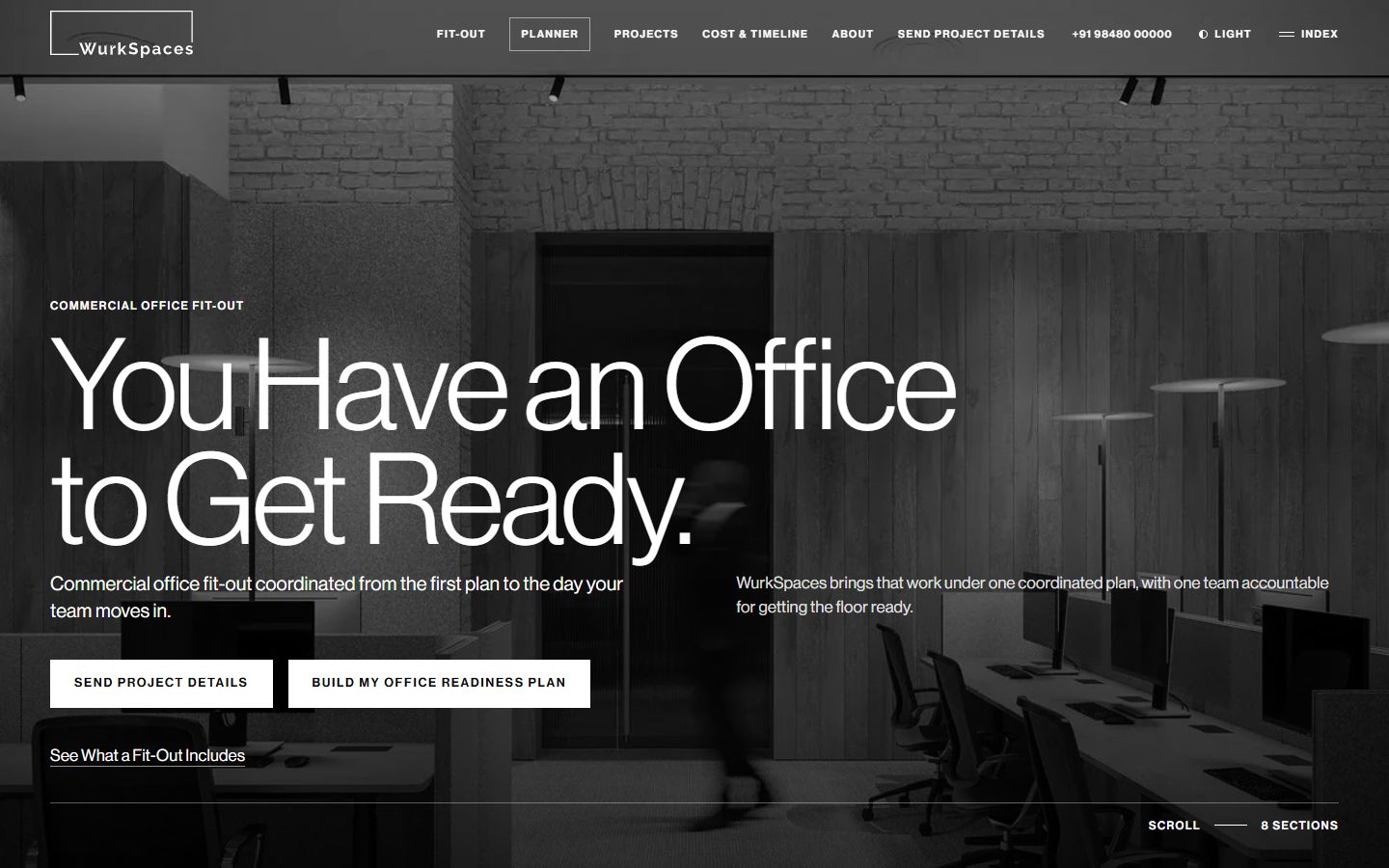
- WurkSpaces, Hyderabad. An office fit-out contractor with eight building systems to explain. The home page is built as an argument, with an interactive floor where picking a system highlights its part of the floor, leading to the case for one plan. The page's job is to make "one contractor for everything" understandable without a sales call. See WurkSpaces.
- AURA. Two builds for one education group, with two different jobs. A campaign landing page asks for one thing, a counselling session. The full degree-college site covers programmes, campus life and a brochure download. Splitting them kept each page honest about what it was for. See AURA.
How does intent help with Google and AI assistants?
A page with one job usually answers one question, and that is the shape search engines and AI assistants find easiest to use. A focused heading, a direct answer near the top, then the detail and proof: Google can match it to the right query, and an assistant can quote it without guessing what you meant.
This is not a trick. It is the same discipline seen from the outside. When we write answer-shaped pages for search and AI visibility, most of the work is making sure each page already knows its job. A page trying to be the services overview, the pricing page and the about page at once gives an assistant three half-answers to choose from. It will usually pick someone else's whole answer. Our guide to answer engine optimisation goes into the mechanics.
Built on assumption versus built on intent
Built on assumption:
- Template decides the pages
- Copy written to fill boxes
- Many pages, overlapping jobs
- Success measured by launch date
- Changes requested by whoever shouts last
Built on intent:
- Jobs decide the pages
- Copy written to answer a reader's question
- Fewer pages, one job each
- Success measured by the signal on each page
- Changes judged against the written job
Does this apply differently in India, the UAE and the UK?
The principle is the same everywhere; the jobs change with how buyers behave. The reader, the channel and the proof they expect differ by market, so the one-line job for the same page can read differently in Hyderabad, Dubai and London.
- India. Many enquiries begin on WhatsApp, and families often decide together. A contact page's job may be to start a WhatsApp conversation with the right context, not to collect a long form.
- UAE. Buyers in Dubai often expect Arabic and English, and trust signals such as a trade licence and a physical address carry weight. A page's job may include proving you are established locally.
- UK. Buyers expect clear prices or price bases, accessible pages and a privacy notice that matches what the site actually does. A page's job often includes removing doubt before a phone call.
What we say no to
Deciding first also means deciding what not to build. We say no to pages that exist because a template had them, to animation that hides the answer, and to identity work that does not fix a sales problem you can name. If we think a page should not exist, you hear it before you pay for it. You can read more about how the studio works.
What to do next
Open your current website and list every page in a column. Next to each, write its job in one line. Mark the pages where you could not finish the sentence. Those are your first decisions: merge, rewrite or remove. If the list is long or the answers are unclear, that is a good sign the site needs a plan before it needs a redesign. Our services start with exactly that plan, and you can book a call to start yours.
What to take away
- Write a one-line job for every page before design starts: who, what action, what signal.
- A page without a job is not neutral. It costs build time, upkeep and search attention.
- Pages with one clear job are easier for buyers to act on and easier for Google and AI assistants to quote.
- If a page cannot be given a job, merge it or cut it.
Built on Intent studio. A founder-led studio in India that plans and builds websites, search and AI visibility, and AI systems for businesses in India, the UAE and the UK. Reviewed by [Founder name], founder. We do not publish invented numbers; where a figure appears, its source is named in the sentence.
How the studio works