Building a business website for Dubai: bilingual content, trust signals and WhatsApp-first enquiries
The short answer
A business website for Dubai has to do three things well: work in Arabic and English in a way that feels written rather than translated, show the trust signals buyers in the UAE look for, such as licence details, a real address and named people, and turn WhatsApp into a reliable enquiry channel rather than a personal inbox. Decide all three before design starts, because each one shapes the layout.
On this page
- The short answer
- What does a business website in Dubai need to do differently?
- How should a Dubai website handle Arabic and English?
- What trust signals do buyers in the UAE look for?
- How do you design for WhatsApp-first enquiries?
- What should the mobile experience look like for Dubai buyers?
- What about search visibility in Dubai?
- What should a Dubai website do about personal data?
- What does a well-built bilingual-ready site look like?
- What to do next
- What to take away
- Questions, answered
A Dubai buyer often meets your business three times before they speak to you: a search result or a referral, your website on their phone, and a WhatsApp message. Each step is a chance to look established and easy to deal with, or to look like one more company that might not reply.
A good Dubai website is designed around those three moments. Here is what that involves.
What does a business website in Dubai need to do differently?
A Dubai business website needs to serve a mixed-language audience, prove the business is established and accountable in the UAE, and handle enquiries on the channel buyers prefer, which is often WhatsApp. It also has to work flawlessly on mobile, where most first visits happen, and respect UAE data protection rules.
None of this is exotic. It is the same discipline as any good website, with three decisions that cannot be left until later: the language plan, the trust plan and the enquiry plan. Each of them changes the layout, so each belongs on the one-page brief before design starts.
How should a Dubai website handle Arabic and English?
Decide first whether Arabic is a full version of the site, a set of key pages or not needed yet. If it is needed, have it written by a fluent writer, give it its own URLs, and design right-to-left layouts properly from the start. A machine-translated Arabic page can do more harm to trust than no Arabic page at all.
Here is the passage we give every Dubai client weighing up Arabic, and it holds on its own. Arabic is not a translation job added at the end; it is a second layout. Text runs right to left, so navigation, icons that imply direction, forms, carousels and even the order of steps in a process diagram need to mirror. Arabic text often runs to a different length than the English, and Arabic typefaces need their own sizing and line height to read comfortably. Numbers, phone formats and dates need a decision too. That is why the scope must be agreed before design: a site planned for English and Arabic from the first sketch costs far less than one retrofitted later. Technically, give each language its own URL path, such as /ar/, mark the page language and direction in the HTML, and connect the versions with hreflang so search engines show the right one. Keep both versions equally current, or the weaker one will undermine the stronger.
If Arabic is not needed yet, say so on the brief and design the system so it can be added later without rebuilding.
What trust signals do buyers in the UAE look for?
Buyers in the UAE look for proof that a business is real, licensed and reachable: trade licence details, mainland or free zone status, a physical address, named people, a local number, real work and honest reviews. These should sit where buyers look, in the footer, the contact page and near every call to action.
Trust signals for a Dubai business website
- Legal business name as on the trade licence
- Licence issuer and number, where you are comfortable showing it
- Mainland or free zone, and the emirate
- Physical address with a map, such as Business Bay or Al Quoz
- Local phone and WhatsApp number that are answered
- Named founder or team, with real photographs
- Real projects with locations and scope
- Prices or price bases in dirhams, with VAT stated
- Privacy notice that matches what the site collects
On prices: UAE VAT applies to most business services, so if you show prices, say whether VAT is included. If you prefer not to publish prices, publish the basis instead: how projects are scoped, what drives cost, typical inclusions. That alone answers much of what a buyer would otherwise ask on WhatsApp.
For sectors where trust is the whole sale, such as property and interiors, see our playbooks on real estate websites in Dubai and Hyderabad and websites for interior designers and architects.
How do you design for WhatsApp-first enquiries?
Make WhatsApp a deliberate enquiry route, not a floating icon. Use click-to-chat links with a pre-filled message naming the page, route them to a shared WhatsApp Business number rather than a personal phone, set expectations on reply times, and record each conversation in your CRM so nothing is lost.
A WhatsApp enquiry that does not get lost
- Page: Service page with a clear WhatsApp button
- Pre-filled message: Names the page and the service
- Shared number: WhatsApp Business, not a personal phone
- First reply: Fast, human or assisted, within stated hours
- Logged: Source, need and next step in the CRM
The common failure is not the button. It is what happens after it. A message arrives on a salesperson's phone on a Friday evening, gets answered on Monday, and nobody knows it came from the villa-renovation page. A shared number, quick replies for common questions and a simple log fix most of that. Where volume justifies it, an assisted first reply can answer the basics out of hours and hand over to a person. Our guide to WhatsApp AI reception covers what to automate and what to keep human, and our work on getting enquiries handled covers the workflow.
What should the mobile experience look like for Dubai buyers?
Most first visits to a Dubai business website happen on a phone, often between meetings or from a WhatsApp link someone forwarded. The mobile version should therefore be the design that gets decided first: what the visitor sees on the first screen, how fast it loads and how few taps it takes to start a conversation.
In practice that means a first screen that says what you do and where, in a sentence rather than a slogan; a visible WhatsApp or call action that does not cover the content; images sized for phones rather than desktop banners squeezed down; and forms short enough to complete with one thumb. If the site is bilingual, the language switch should be obvious on mobile and should take the visitor to the same page in the other language, not back to the home page. Test on a mid-range Android phone as well as an iPhone, because your buyers use both. A beautiful desktop design that takes a long time to load on a phone in a car park loses the enquiry before it starts.
What about search visibility in Dubai?
Search in Dubai works like search anywhere, with local specifics: a claimed Google Business Profile with the right area, pages that name the communities you serve, and separate Arabic pages if Arabic searchers matter. If you also serve India or the UK, structure the markets carefully so pages do not compete with each other.
Name areas honestly. A design studio in Al Quoz that works mostly in Dubai Hills, Arabian Ranches and Jumeirah can say so, with projects to match. A consultancy in DIFC or Business Bay serving clients across the Gulf can say that too. Our guide to international SEO across India, the UAE and the UK explains how to separate markets without duplicating pages, and our Dubai page covers how we work with UAE businesses.
What should a Dubai website do about personal data?
Collect only what you need, explain it in a clear privacy notice, secure the forms and the inbox they feed, and get consent where it is required, for example before marketing messages. Onshore businesses are generally covered by Federal Decree-Law No. 45 of 2021, while DIFC and ADGM have their own regimes. Take legal advice.
The practical website points are simple. Do not ask for an Emirates ID number or date of birth on a general enquiry form. Make sure cookie and analytics choices are honest about what the site loads. If enquiries flow into WhatsApp, a CRM and email, know where each copy lives and who can see it.
What does a well-built bilingual-ready site look like?
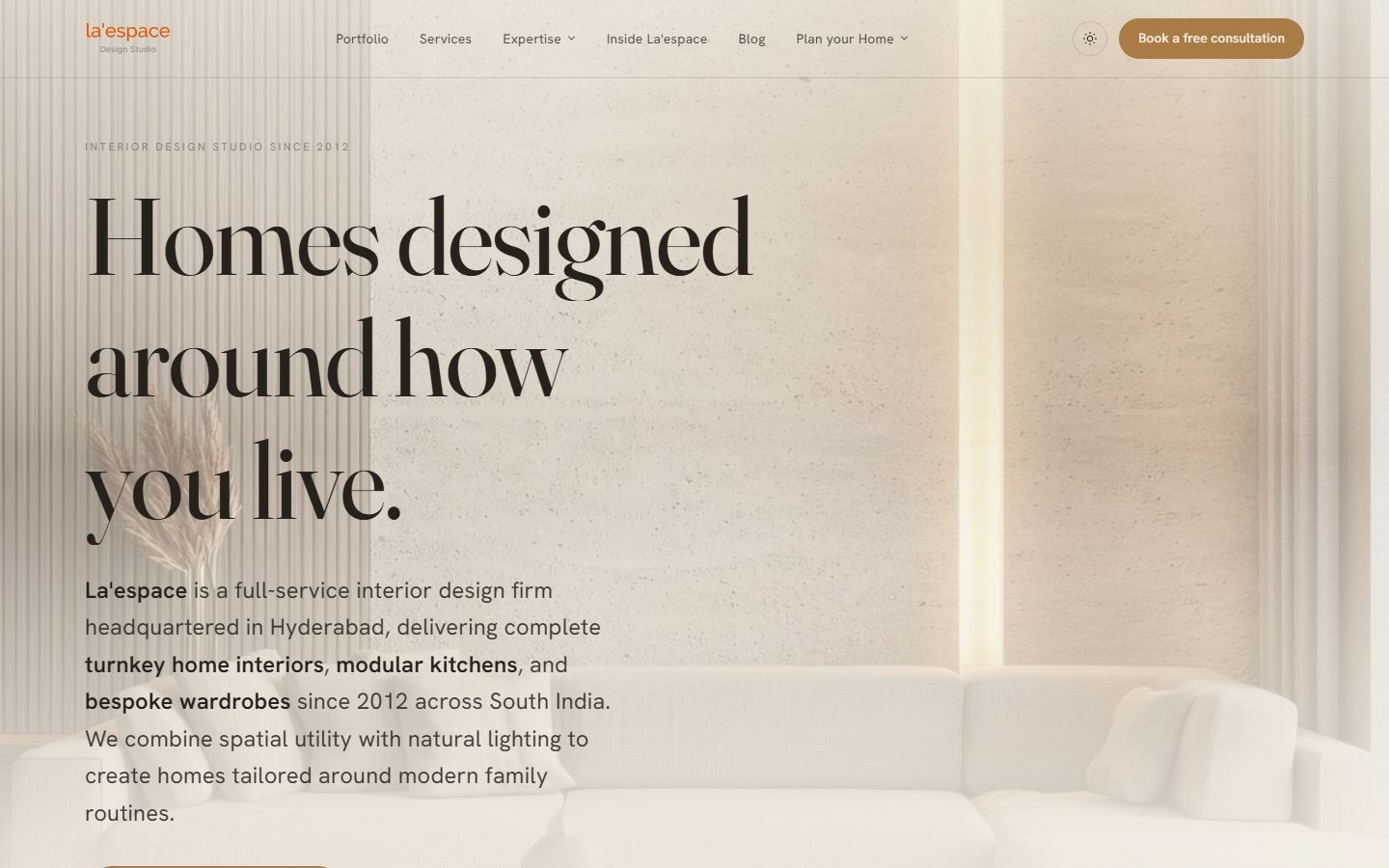
It looks calm, specific and fast on a phone, with one clear action per page. Our studio's work shows the approach even where the sites are English-first: LaEspace, an architecture and interior design studio, opens with "Homes designed around how you live." and keeps every page focused on the kind of home it designs. Every project starts with the decisions, then the design.
What to do next
Look at your last twenty enquiries. Note the language each arrived in, the channel, and the question asked first. That tells you whether Arabic is needed, whether WhatsApp should be the main route and which trust signals buyers are checking. Bring those notes to a call, and we will turn them into a plan for the site.
What to take away
- Decide the scope of Arabic early: full site, key pages or none. Right-to-left layout affects design from the first sketch.
- Show trust signals buyers can check: trade licence details, mainland or free zone, address, named people, real work.
- Make WhatsApp the main enquiry route if your buyers use it, and log every conversation.
- Keep prices, if shown, in dirhams with VAT made clear, and take legal advice on personal data.
Built on Intent studio. A founder-led studio in India that plans and builds websites, search and AI visibility, and AI systems for businesses in India, the UAE and the UK. Reviewed by [Founder name], founder. We do not publish invented numbers; where a figure appears, its source is named in the sentence.
How the studio works