Travel and DMC websites: itineraries, enquiries and international search
The short answer
A travel or DMC website has to do three things: make a destination feel real, prove the company can deliver it, and turn interest into a qualified enquiry. That means sample itineraries written day by day, honest notes on seasons and inclusions, an enquiry form that asks for dates, group size and travel style, and pages structured so travellers and agents in India, the UAE and the UK can each find them.
On this page
- The short answer
- What is a DMC, and what does its website need to do?
- How should a sample itinerary page be written?
- How do agents and direct travellers differ?
- How should a travel website show it can deliver?
- What should a travel enquiry form ask?
- How does a travel website get found in India, the UAE and the UK?
- What to do next
- What to take away
- Questions, answered
Travel websites have an unusual problem. They are very good at the first moment, the beautiful photograph of a mountain or a temple at dawn, and often weak at every moment after it. A visitor feels the pull of a destination, then cannot find how many days it needs, what is included, when to go or how to ask. The feeling fades, and the tab closes.
This playbook is for travel companies and destination management companies selling to travellers and agents in India, the UAE and the UK. It draws on the site our studio built for Orange DMC, a hospitality and events business offering experiential travel in India and Sri Lanka.
What is a DMC, and what does its website need to do?
A destination management company is a local operator that designs and runs travel in its own region: hotels, transport, guides, experiences and events. Its website has to make the destination feel real, prove the company can deliver on the ground, and turn interest into a qualified enquiry from a traveller or a trade partner abroad.
Those three jobs pull in different directions, which is why many travel sites manage only the first. Inspiration needs space, film and photography. Proof needs specifics and evidence. Enquiry needs a short, well-designed form. A site built on intent gives each job its own place, in that order, rather than asking one gallery page to do all three.
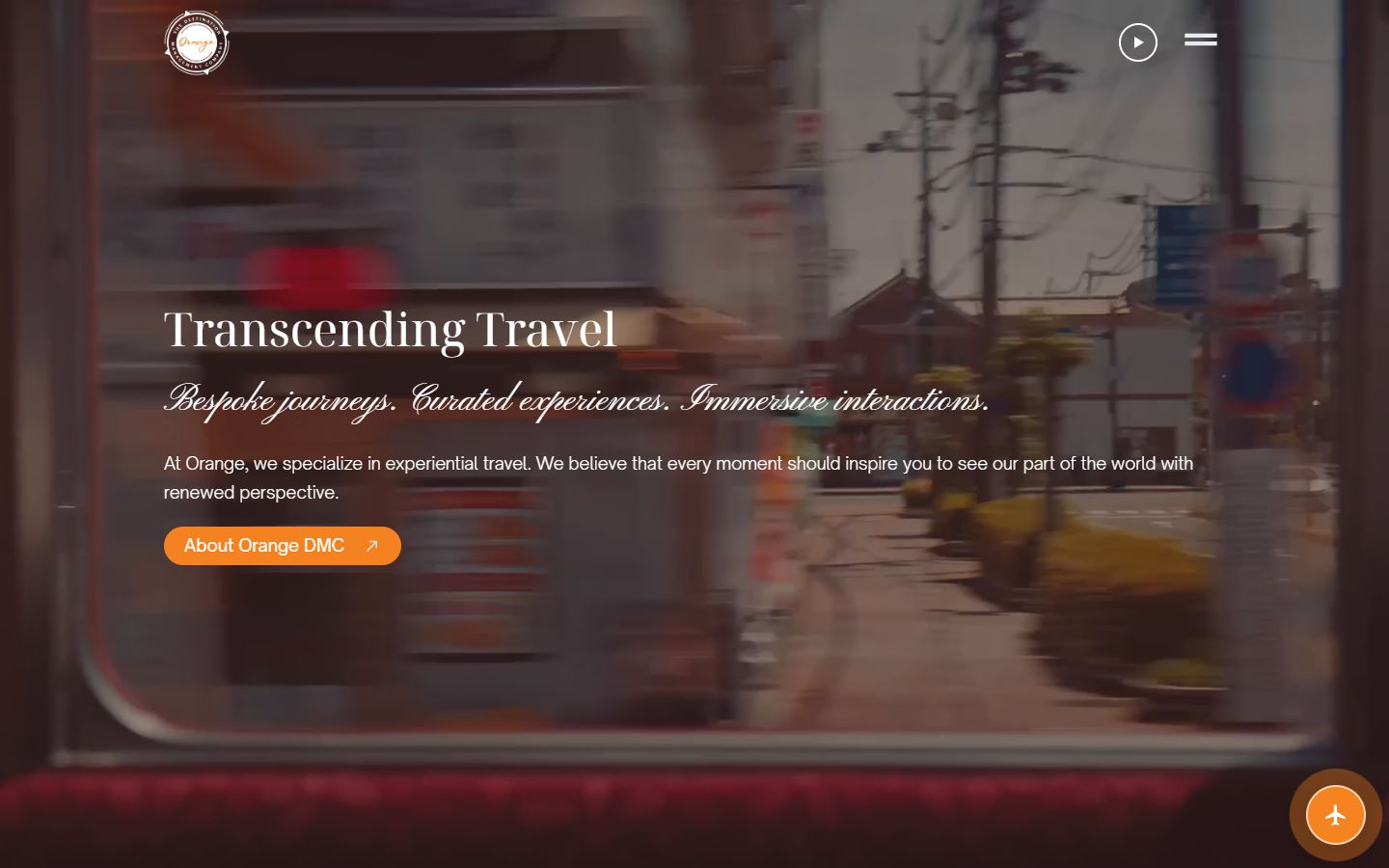
The Orange DMC site shows the shape. It opens with a full-screen film and a plain statement of what the company does: bespoke journeys, curated experiences and immersive interactions. An experiences section follows, then destination panels for India and Sri Lanka, each with its own short line and a link to explore. A section of traveller feedback carries the proof in other people's words. A fixed action button stays in reach on every screen.
How should a sample itinerary page be written?
Day by day, with enough detail to plan around. State the number of days, the route, the pace, what is included and what is not, the best months to travel and who the trip suits. A sample itinerary is not a promise of exactly that trip; it is evidence that you know the ground.
A useful structure, which we adapt for each client:
- Summary. Duration, route, pace, best months, and who it suits.
- Day by day. Where the traveller wakes, what they do, how far they travel, where they sleep.
- Inclusions and exclusions. Hotels by category, transport, guides, meals, entry fees, and what is not covered.
- Seasons. When to go and when to avoid, explained honestly.
- Variations. How the trip changes for families, groups, slower pace or a special interest such as golf or food.
- Enquire. One action, with the itinerary name carried into the form.
This is the passage we would ask every travel founder to read. A visitor who has never been to Kerala or the hill country of Sri Lanka cannot judge whether ten days is enough or whether a five-hour drive between stops is tiring. A day-by-day itinerary answers that without a call. It also shows the judgement that separates a good operator from a booking engine: knowing that a particular road is slow in the monsoon, that a temple is best before the crowds, that a family with young children needs a rest day after a long transfer. Seasons deserve real candour. India's monsoon shapes travel across much of the country, and Sri Lanka has two monsoon seasons that affect different coasts at different times. Saying so builds more trust than a page that implies every month is perfect.
How do agents and direct travellers differ?
Agents and tour operators want to know whether you can deliver reliably for their clients: your coverage, your suppliers, how you handle problems and how you work with partners. Direct travellers want to know what the trip will feel like and what it costs. Give each its own path from the home page, with different questions answered.
A trade partner page can explain the kinds of travel you handle, such as private tours, groups, incentives or events, the regions you cover, and how to request rates. Trade fairs such as WTM in London, Arabian Travel Market in Dubai and ITB Berlin are where many partnerships start; a partner page gives a contact made at a stand somewhere to land afterwards.
How should a travel website show it can deliver?
With evidence a partner or traveller can weigh: real feedback in travellers' own words, named destinations you operate in, the kinds of groups you have handled, and photographs from your own trips rather than stock. Proof matters more in travel than in most sectors, because the buyer pays before they experience anything.
Traveller feedback works best when it is specific. A comment that mentions the driver's punctuality, a golf day or a particular guide tells a future client far more than a line of praise. Keep the original wording, attribute it as far as the traveller allows, and never write it yourself. For trade partners, a short description of the services you run on the ground, and how you handle a missed connection or a sudden change of plan, answers the question they are really asking: will you protect my client and my reputation?
What should a travel enquiry form ask?
Enough to send a real proposal in the first reply, and no more. Travel month or dates, number of travellers, the country they travel from, interests, travel style or hotel category, and a budget range if framed helpfully. Mark which fields are optional, and carry the itinerary name into the form automatically.
From inspiration to a confirmed trip
- Inspire: Film, photography, destination pages
- Plan: Day-by-day sample itinerary
- Enquire: Dates, group size, interests, style
- Propose: A tailored itinerary within a day
- Confirm: Clear terms, deposit, pre-trip notes
Speed matters after the form. A traveller comparing operators often enquires with several at once, and the one who replies with a thoughtful proposal first is at an advantage. Automation can acknowledge the enquiry instantly, share the relevant itinerary and book a call, while a person prepares the proposal. We explain how in automating lead follow-up without losing the personal touch. Many travellers in India and the Gulf prefer WhatsApp for these conversations; see WhatsApp AI reception.
How does a travel website get found in India, the UAE and the UK?
Through destination and itinerary pages that answer real questions, structured clearly for each market you sell to. Travellers search by destination, duration and style, such as a ten-day Rajasthan itinerary or a family trip to Sri Lanka. Each such query deserves a page that answers it directly in its opening lines.
What each source market asks first
- UK: Prices in pounds, school holiday timing, package protection questions, email first
- UAE and the Gulf: Family groups, school holiday travel, WhatsApp contact, quick replies
- India: Close comparison of inclusions, hotel categories, domestic and regional routes
Different source markets need different details. UK travellers and agents think in pounds and UK holiday seasons, and may ask about financial protection for package holidays; take advice on what applies to you. Gulf travellers often travel in family groups around school holidays and value WhatsApp contact. Indian travellers booking domestic or regional trips compare closely on inclusions. Where audiences genuinely differ, give them separate pages, and use hreflang only for true language or regional versions. Our guide to international SEO for India, the UAE and the UK covers the structure in detail, and our notes on the UK and Dubai cover each market.
AI assistants increasingly plan trips for people. They quote pages that state facts plainly: durations, routes, seasons, inclusions. A sample itinerary written day by day is exactly that kind of page. We explain more in generative engine optimisation.
What to do next
Choose your three most requested trips and write each as a day-by-day sample itinerary with seasons and inclusions. Check your enquiry form asks for dates, group size and travel style, and that someone replies within a day.
When you are ready, see how we build websites and platforms, search and AI visibility and enquiry automation for travel businesses across India, the UAE and the UK, or book a call.
What to take away
- Inspiration brings visitors in; specific itineraries turn them into enquiries.
- Write sample itineraries day by day, with pace, inclusions and the best months.
- Serve agents and direct travellers on separate paths with different questions.
- Ask for dates, group size and travel style so the first reply can be a real proposal.
- Structure pages by destination and source market for international search.
Built on Intent studio. A founder-led studio in India that plans and builds websites, search and AI visibility, and AI systems for businesses in India, the UAE and the UK. Reviewed by [Founder name], founder. We do not publish invented numbers; where a figure appears, its source is named in the sentence.
How the studio works