Pricing psychology for service businesses: structuring offers buyers can say yes to
The short answer
Buyers say yes to service offers they can understand quickly, compare fairly and trust. Structure a small number of clearly named offers, each tied to an outcome and a defined scope, show what is included and excluded, use a sensible anchor, and make the first step low-risk. Pricing psychology works best when it reduces confusion, not when it manipulates.
On this page
- The short answer
- What is pricing psychology for service businesses?
- Why do buyers fail to say yes to service offers?
- How should you structure service offers?
- How does anchoring work without being manipulative?
- Should you publish prices?
- What pricing mistakes do service businesses make most often?
- How does the first step reduce risk?
- Where does the website come in?
- What to do next
- What to take away
- Questions, answered
Most service businesses think their pricing problem is the number. More often it is the structure. Buyers see a list of services, a vague "contact us for a quote", or four packages with overlapping features and names like Silver, Gold and Platinum. They cannot tell what they would get, so they postpone the decision. Postponed decisions rarely come back.
Pricing psychology, used well, is mostly about removing that confusion.
What is pricing psychology for service businesses?
Pricing psychology is the study of how people perceive and decide on prices. For service businesses it means structuring offers, tiers, names and price presentation so buyers understand what they are buying, can compare options fairly, and feel safe saying yes. Used honestly, it reduces friction; used cynically, it erodes trust.
The well-known ideas, such as anchoring, the appeal of a middle option, and the way too much choice can stall a decision, are real and widely discussed in behavioural economics. But for a service business they matter mainly as tools for clarity.
Why do buyers fail to say yes to service offers?
Buyers stall when they cannot quickly answer three questions: what will I get, how does it compare, and what happens if it goes wrong. Price matters, but unclear scope, too many options and high perceived risk lose more deals than a number that is slightly too high.
This passage is the one we lead with when a client asks us to review their pricing page. A buyer considering a service is being asked to pay now for something they will only receive later, from people they do not yet know. Every unanswered question adds risk to that decision. If the scope is vague, they worry about hidden extras. If there are six packages, they worry about choosing the wrong one. If there is no price at all, they worry it will be far beyond their budget and that a call will become a sales pitch. Each worry is a reason to wait. The job of a well-structured offer is to answer those worries before they are voiced: name the outcome, define the scope, show the price or the pricing logic, limit the choices, and make the first commitment small. Do that, and the price itself becomes one factor among several rather than the only thing the buyer can compare.
How should you structure service offers?
Structure a small number of offers, each named for the job it does, each with a defined scope, a clear inclusion and exclusion list, and a price or pricing approach. Arrange them so the most common buyer sees an obvious fit, with a smaller and a larger option on either side.
Building blocks of an offer buyers understand
From the bottom layer up:
- The outcome: What the buyer gets, in their words
- The scope: What is included, what is not
- The process: How it runs and what the buyer does
- The price: Or a clear pricing approach
- The first step: Small, defined, low risk
Practical rules:
- Name by outcome. "Website modernisation" or "Admissions enquiry system" says more than "Growth package".
- Two or three options. Enough for comparison, few enough to decide.
- Design the middle. Make the middle option the right fit for most buyers, with honest reasons.
- List exclusions. Saying what is not included builds as much trust as listing what is.
- Show the process. Buyers relax when they can see the steps.
How does anchoring work without being manipulative?
Anchoring works honestly when every option shown is real, well made and genuinely right for some buyers. Presenting a comprehensive option first gives context for a focused one. It becomes manipulation when an option exists only to make another look cheap, and buyers usually sense that.
A simple test: would you be happy if a buyer chose your highest option? If yes, it is a real offer and a fair anchor. If you would be uncomfortable delivering it, remove it.
Should you publish prices?
Publish prices, or at least starting prices and a clear pricing approach, wherever scope is predictable enough. It filters out poor-fit enquiries and builds trust. Where scope genuinely varies, explain what drives the price and give ranges or examples rather than hiding behind "contact us".
Market habits differ, so think about your buyers:
- UK: buyers often expect transparent pricing or at least a clear starting point, and are wary of "price on application" for routine services.
- India: buyers may expect some negotiation, so structure tiers so that discounting is replaced by choosing a smaller scope. State whether prices include GST.
- UAE and Dubai: clarity on what is included matters, as does stating whether prices include VAT. Bilingual offer pages should keep scope wording identical in Arabic and English.
Pricing presentation by market
- India: Offer smaller scopes instead of discounts; state GST treatment
- UAE: Clear inclusions, VAT stated, matching Arabic and English
- UK: Starting prices or ranges expected; plain terms
What pricing mistakes do service businesses make most often?
The most common mistakes are too many packages, names that say nothing, features listed without outcomes, no exclusions, discounts used to rescue unclear offers, and prices that differ depending on who asks. Each one adds doubt. Most can be fixed by rewriting the offer page rather than changing the price.
A closer look at the patterns we see:
- Feature lists without outcomes. "Five pages, two revisions, one month of support" tells a buyer what you do, not what they get. Lead with the result, then list the features that deliver it.
- Discounting as a closing tool. If a buyer hesitates and the answer is always a lower price, the offer teaches buyers to hesitate. Offering a smaller scope keeps the price honest.
- Inconsistent quotes. If two similar buyers compare notes and find very different prices, trust drops for both. A written pricing approach keeps quotes consistent.
- Everything is custom. Some work truly varies, but most service businesses have a common core. Package the core; quote only what genuinely differs.
Fixing these is usually a writing and structure task, which is why it sits alongside messaging rather than finance.
How does the first step reduce risk?
A small, clearly defined first step lets a buyer test the relationship before committing to the full engagement. It might be a diagnosis, an audit, a paid plan or a short pilot. The buyer gets something useful on its own, and both sides learn whether the larger project makes sense.
We use this ourselves. Every engagement begins with a written plan, agreed before design starts, and the first call ends with a plan the client keeps whether or not we work together. That is described on our studio page and in the one-page website brief. It is building on intent applied to selling: decide what the buyer is agreeing to before asking them to agree.
Where does the website come in?
Your website is where most buyers first meet your offer, so the pricing structure needs a page built around it: offers named by outcome, scope and exclusions visible, a pricing approach stated, and a clear first step. A strong offer hidden in a PDF or a sales call loses buyers who never ask.
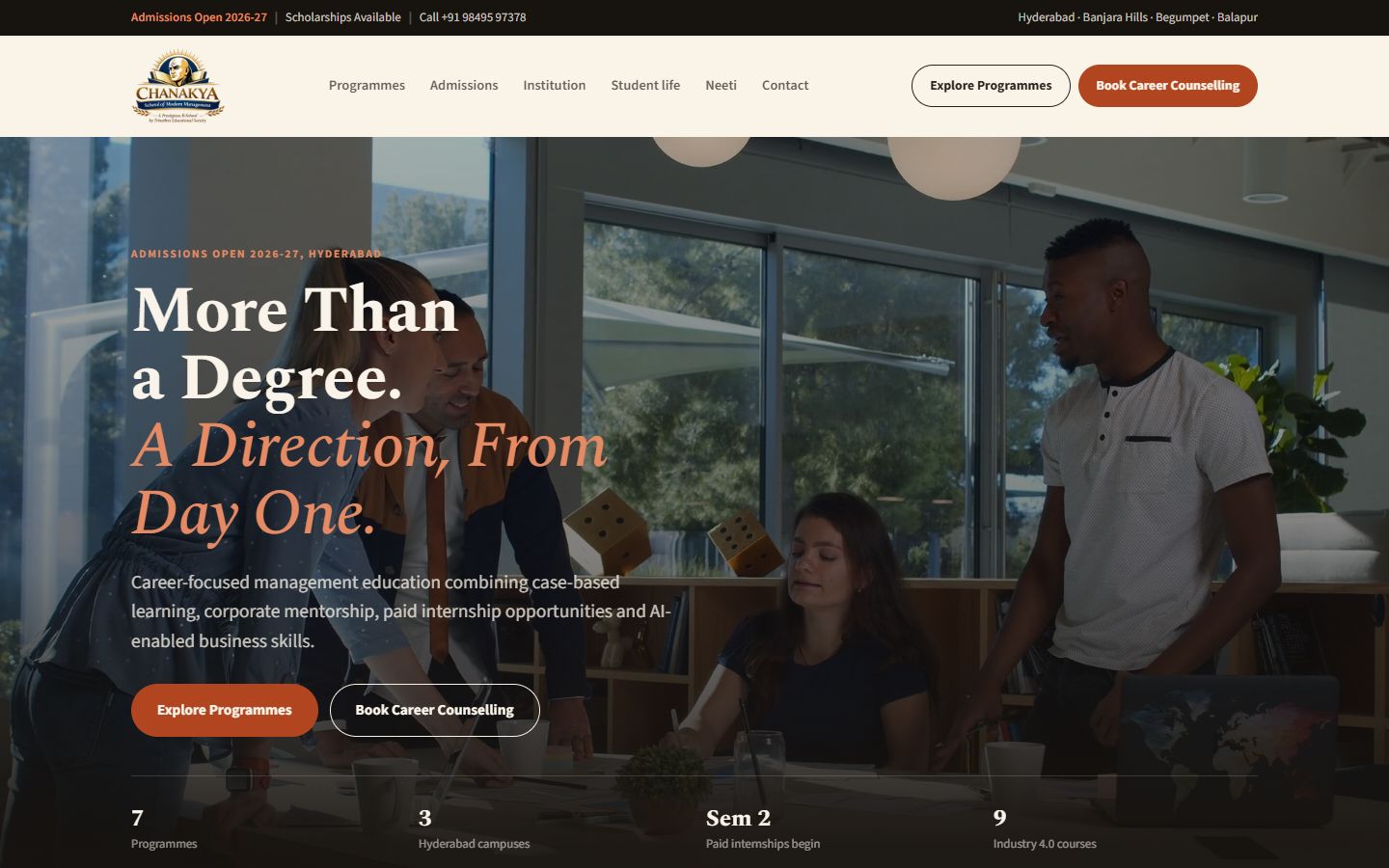
Offer structure and sales messaging are part of our brand strategy and websites work. A site such as Chanakya, with its fees table published and its admissions process set out step by step, shows how much easier a decision becomes when the numbers and the process are in plain view. Once buyers enquire, lead follow-up automation makes sure the clarity continues into the first conversation.
What to do next
Print your current services or pricing page and read it as a buyer would. For each offer, try to answer: what do I get, what is not included, how much, and what is the first step? Mark every question you cannot answer from the page.
Those marks are your restructuring brief. Book a call and we will help you turn them into offers buyers can say yes to.
What to take away
- Confusion kills more deals than price does.
- Name offers by the job they do, not by metal colours.
- Two or three options are easier to choose from than many.
- State what is included and, just as clearly, what is not.
- A small, defined first step lowers the risk of saying yes.
Built on Intent studio. A founder-led studio in India that plans and builds websites, search and AI visibility, and AI systems for businesses in India, the UAE and the UK. Reviewed by [Founder name], founder. We do not publish invented numbers; where a figure appears, its source is named in the sentence.
How the studio works